Monitor surface displacement| Critical infrastructure | Data integration

Block caving is an underground hard rock mining method that involves undermining an ore body, allowing it to progressively collapse under its own weight. In this case, it has led to surface subsidence in an existing open pit mine and its surrounding infrastructure. A comprehensive monitoring program has been implemented to address this.

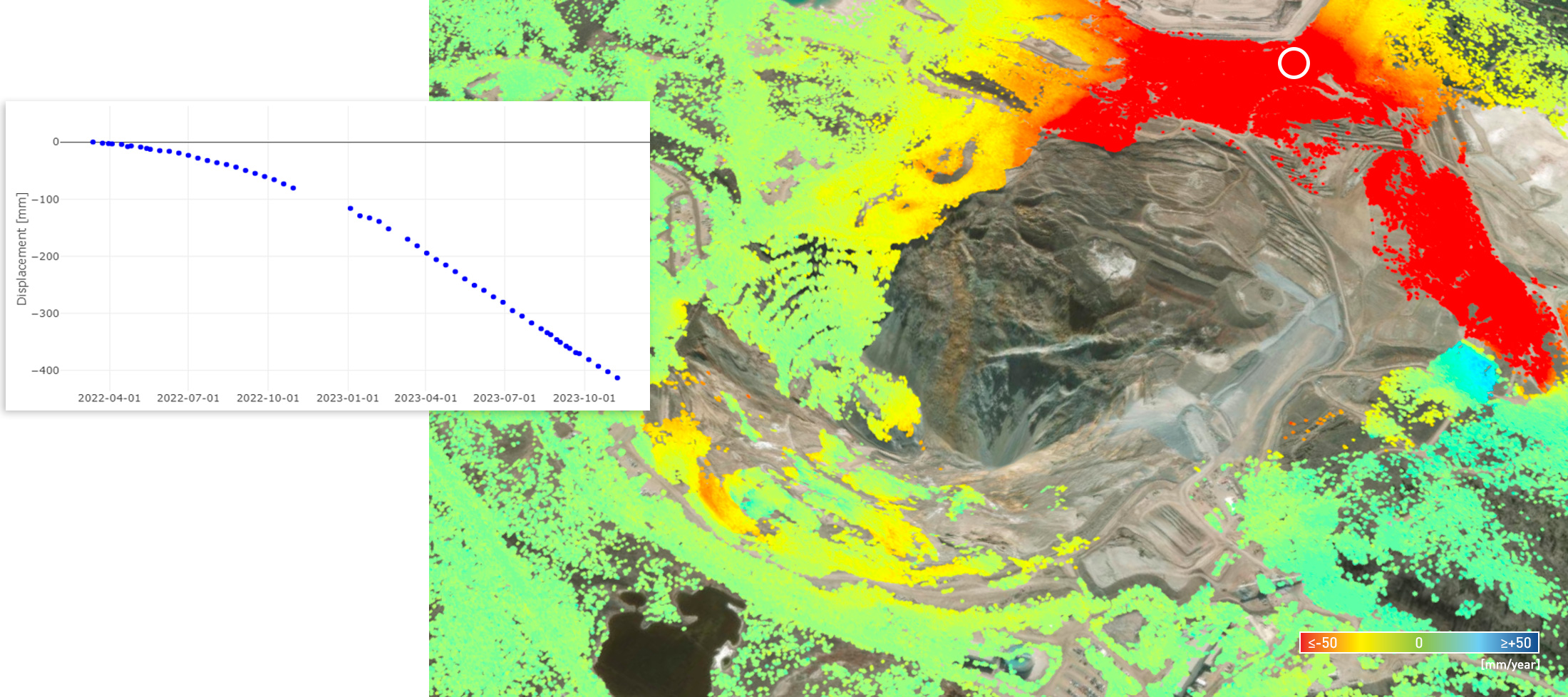
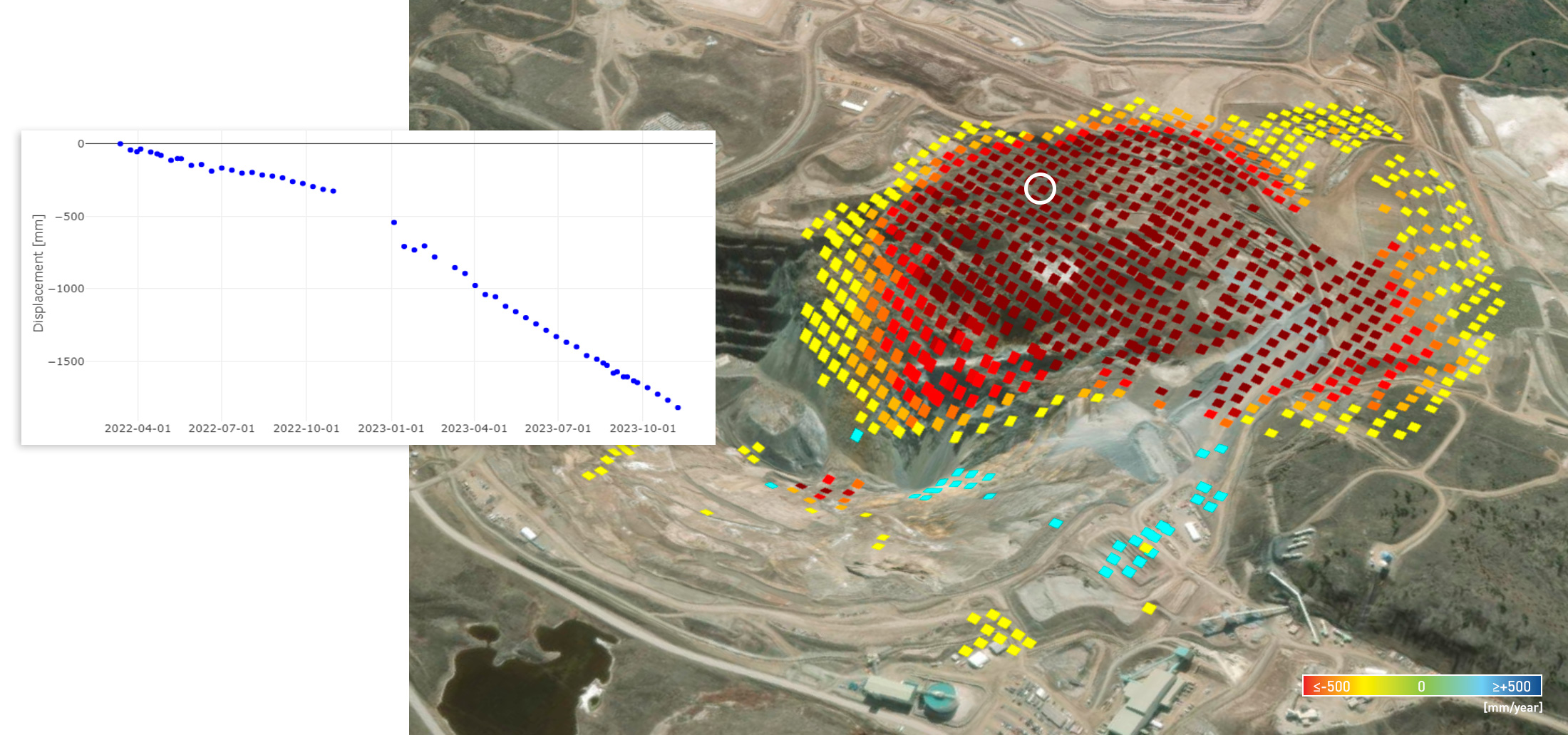
SqueeSAR® and Rapid Motion Tracking (RMT) data on the open pit area. ©DLR e.V. 2022-2023, Distribution by Airbus Defence and Space GmbH.

The program aims to track surface displacement and assess the impact on critical infrastructure. Two SAR processing techniques are used to monitor the large range of surface displacement rates often encountered with this approach: SqueeSAR® and Rapid Motion Tracking (RMT).

SqueeSAR® results with time series of ground displacement. Displacement rates ranging from 0 to over -400 mm. ©DLR e.V. 2022-2023, Distribution by Airbus Defence and Space GmbH.
RMT results with time series of ground displacement. Displacement rate ranging from 0 to over -1500 mm. ©DLR e.V. 2022-2023, Distribution by Airbus Defence and Space GmbH.

SqueeSAR®

SqueeSAR® is an InSAR technique that uses the signal’s phase information for surface displacement detection.
It is useful for:

  • Monitoring slow ground displacement
  • Identifying accelerations and non-linear displacement
  • Provides a history of displacement
  • Millimetre precision
  • High spatial resolution (density up to 20,000 pts/km2)
  • 2D components (Vertical and East-West components of displacement)

Rapid Motion Tracking (RMT)

RMT is a pixel-tracking technique that uses the signal’s amplitude component to detect surface displacement.
It is useful for:

  • Monitoring rapid ground displacement (up to tens of meters per year)
  • Identifying accelerations and non-linear displacement
  • Provides a history of displacement
  • 3D components (Vertical, East-West and North-South components of displacement)

This InSAR monitoring program provides valuable insights into the extent and evolution of surface subsidence caused by underground block cave mining. The data collected helps to assess the impact on infrastructure and enables informed decision-making to mitigate risks and ensure safety.